
goldsmith company
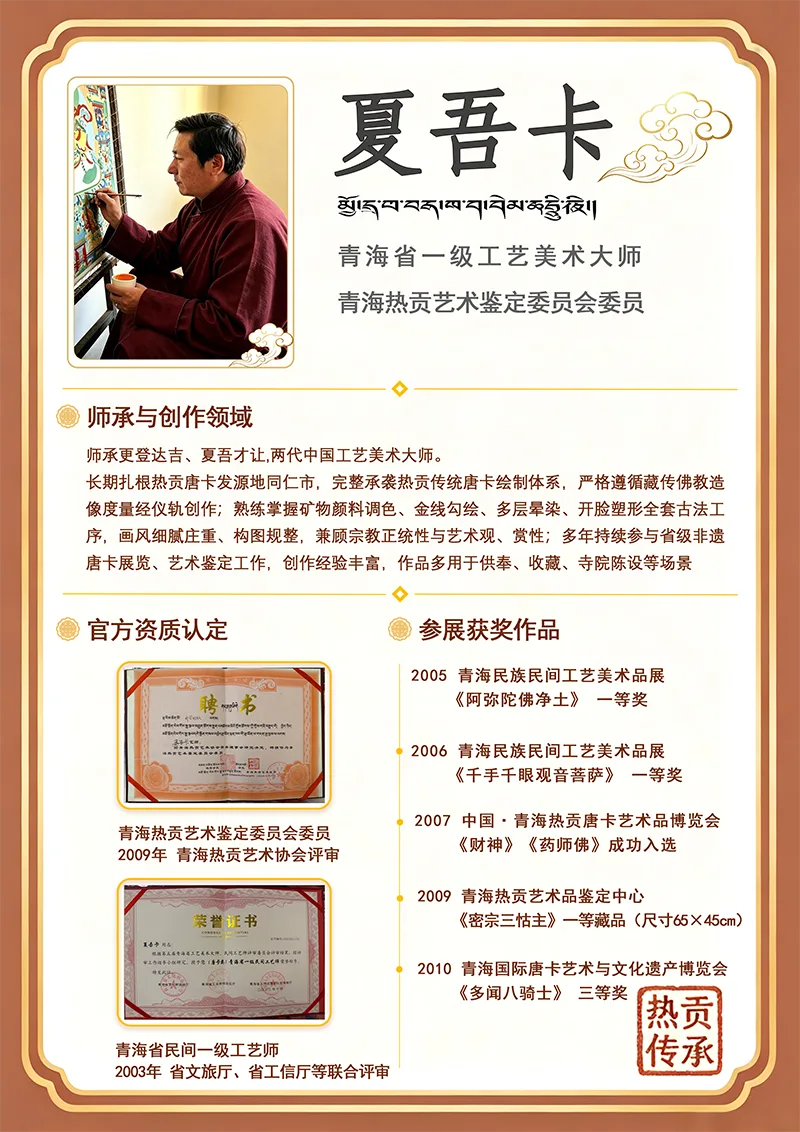
夏吾卡
Rules are the foundation of my twenty years of painting
The people from Thangka Treasure came to Regong and asked if I would tell my story to the world. I have no earth-shattering tale — only twenty-odd years of painting by the rules.
My name is Xiawuka. I am from Tongren, Regong. I paint thangkas — and I serve on the Qinghai Regong Art Appraisal Committee.
Where the rules came from
I studied under two masters — Gendun Dargye and Xiawu Cairang, both China Arts and Crafts Masters. The first thing they taught me was not how to move the brush, but the rules: in the iconometric canon, the distance between a Buddha’s brows, the length of a ritual implement, the number of folds in the robe — all are fixed, and not a hair’s breadth may be altered. My masters said: painting a thangka is not painting; it is creating a sacred image. Images are made to be venerated. Draw one part wrong, and you have been disrespectful to the faith itself.
I have remembered that for more than twenty years.
Their road, and mine
Among the painters of Regong, some went to the big cities, some rode the wave of the internet. I never left Regong — since the day I was apprenticed, I have stayed by this river valley. Not because there were no chances, but because I could not leave: the monasteries here, the devotees here, the thangkas here — they need someone who keeps the rules.
Over the years I have seen too many paintings that took the shortcut: chemical pigments that turn grey within a year; machine-printed “thangkas” sold as hand-painted; icon proportions casually altered to look “nicer”. Every time I see it, it stings. Thangka was inscribed on the intangible cultural heritage list precisely because of the handcrafted process that cannot be simplified. If I took the shortcut too, what I painted would no longer be a thangka.
The way I paint
For pigments, I use the natural minerals and plants of the highlands — I grind and mix them myself, layering shade upon shade. Natural colors are warm and deep; they do not fade for a hundred years. For the gold line, I grind gold powder by hand and trace the halo, the robe patterns and the ornaments stroke by stroke. The hardest part is the finishing of the face: a Buddha must be compassionate, a Bodhisattva serene, a protector majestic — the right measure rests on that final stroke. A painting takes months, sometimes years. I never hurry myself.
I never skip a step. Because I know these paintings will hang in monasteries and rest in devotees’ homes, watched for decades, for a century. I cannot deceive them.
The painter, and the appraiser
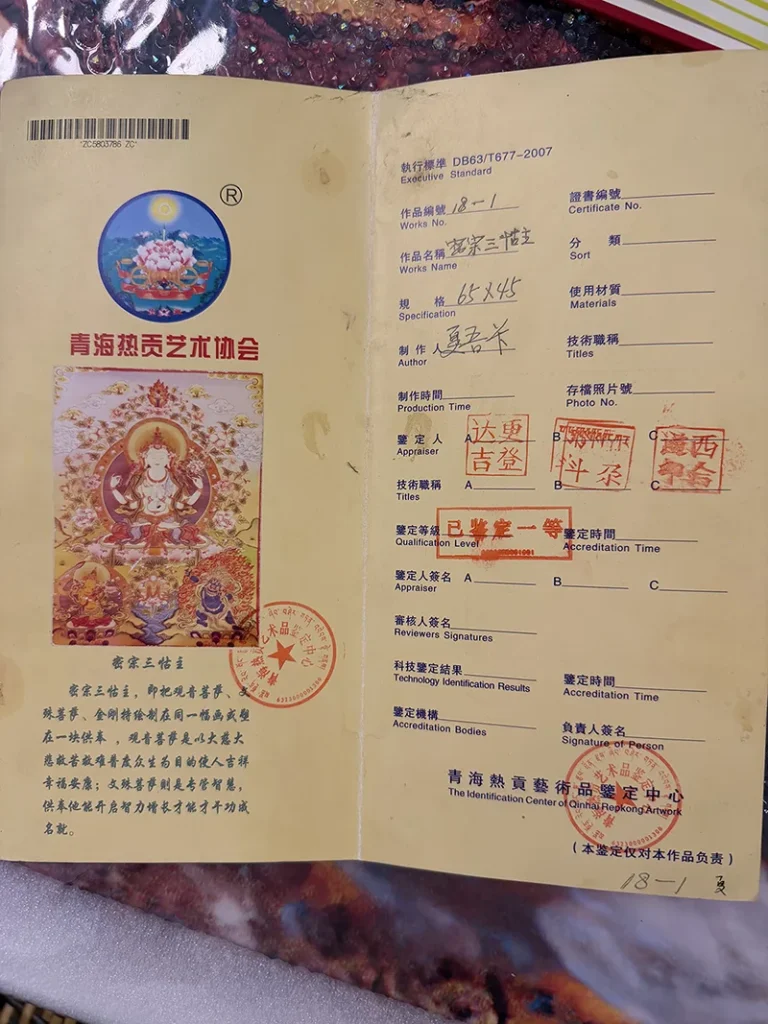
In 2009, I was appointed to the Qinghai Regong Art Appraisal Committee. A painter, grading and authenticating other people’s works — a heavy responsibility. My standard is simple: if I could not paint it myself, or would not sign my name to it, I will not stamp it as authentic. I turn twenty years of feel into a ruler — measuring others’ paintings, and my own conscience.
In all these years of grading and authentication, what pleases me most is that more and more collectors have begun to insist on “orthodox”. When a trade has standards, the painters who work honestly can make a living.
A ledger of twenty years
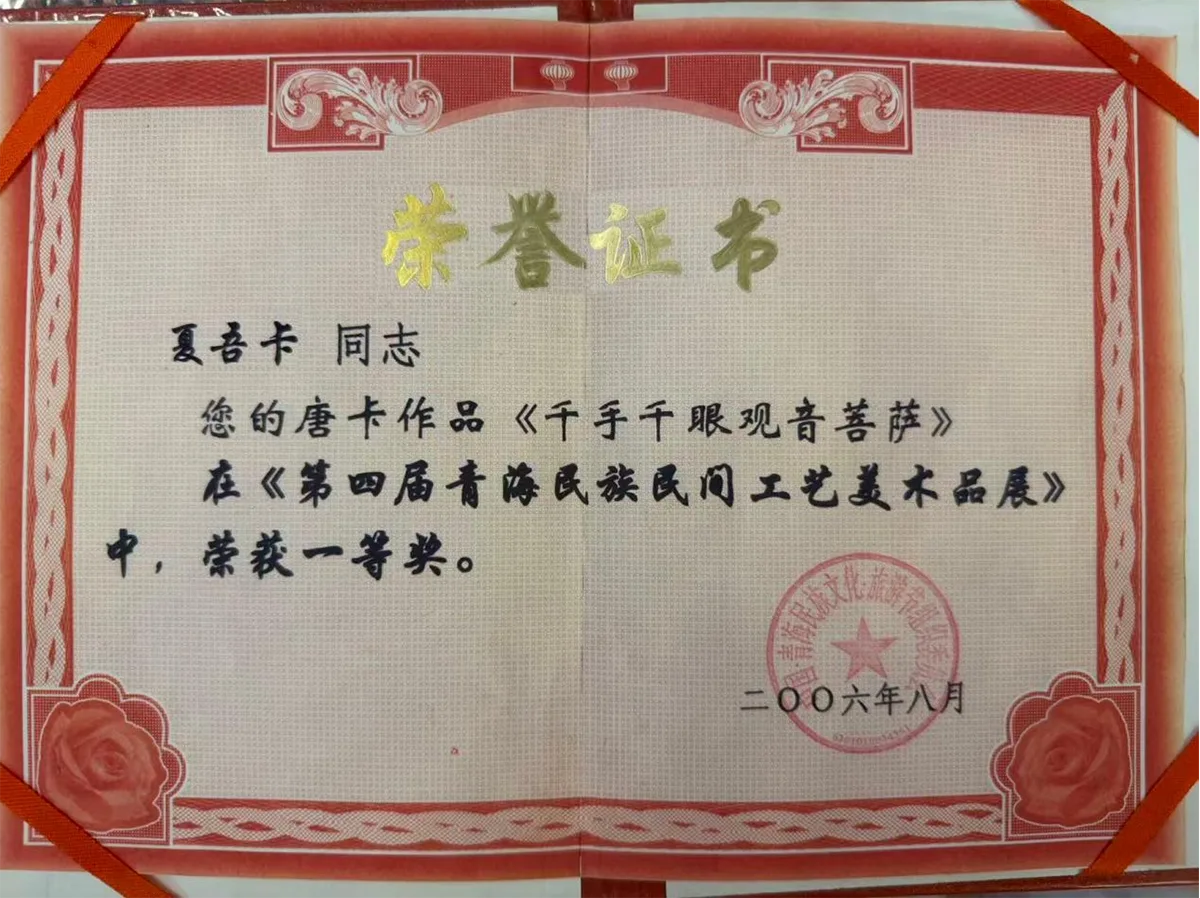
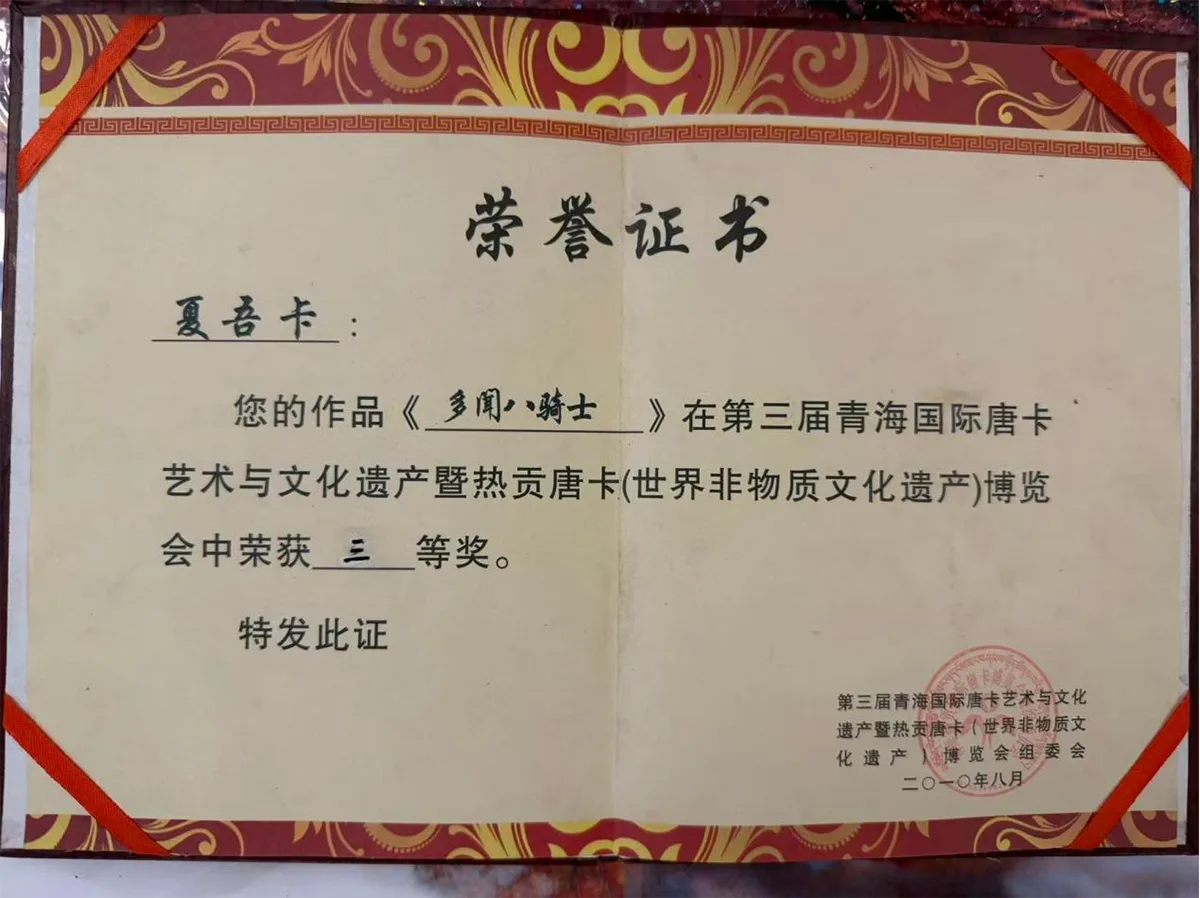
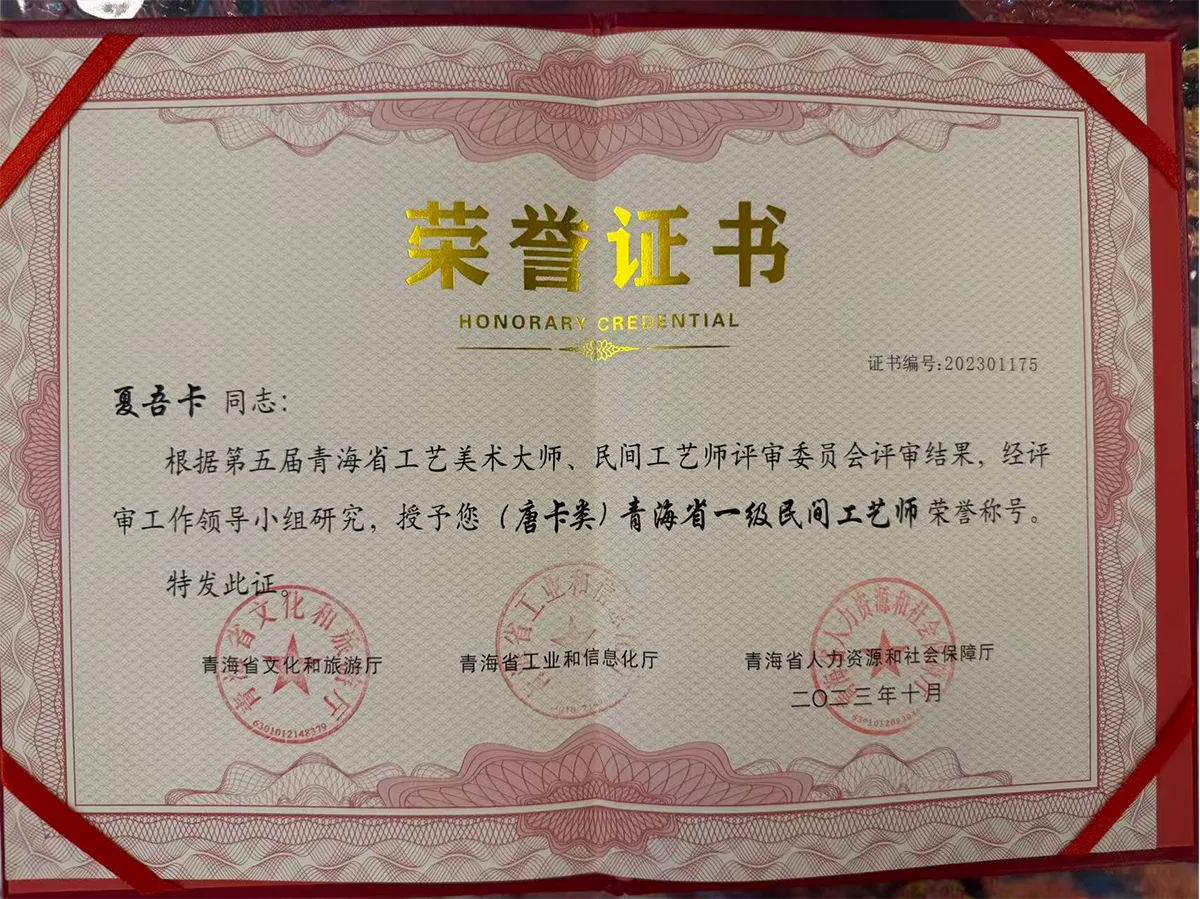
2005 — “Amitabha’s Pure Land”: First Prize, Qinghai Folk Arts & Crafts Exhibition. 2006 — “Thousand-Armed, Thousand-Eyed Avalokitesvara”: First Prize, the same exhibition series. 2007 — “Jambhala” and “Medicine Buddha” selected for the China-Qinghai Regong Thangka Art Fair. 2009 — “Three Protectors of the Vajrayana” rated a First-Class Collectible, and in the same year I was appointed to the Appraisal Committee. 2010 — “Eight Vaishravana Riders”: Third Prize, Qinghai International Thangka Art & Cultural Heritage Expo. 2014 — First-Grade Arts & Crafts Master of Huangnan Prefecture. 2023 — First-Grade Folk Artisan of Qinghai Province (thangka category).
These are not trophies to show off. They are the record of a man who kept the rules, over twenty years.
Passing it on
Today I also train young apprentices of my own — iconometry, mineral pigment preparation, line drawing and shading. I do not expect them to become famous overnight. I only hope they remember what my masters passed to me: painting a thangka is not painting; it is creating a sacred image. Keep the rules, and the craft will not be broken.
Why I work with them
When Thangka Treasure came to me, I asked them one question: “Do you sell thangkas with promises of consecration and miracles?” They said: “We only speak of Regong’s craft, the artists’ stories, and the truth of the work.” That settled it — they, like me, are people who keep the rules.
The lineage of Regong has passed for a thousand years. I am one link in the chain. If I hold this link well, I have done right by my two masters.
— Xiawuka, Intangible Heritage Painter of Regong
