
goldsmith company
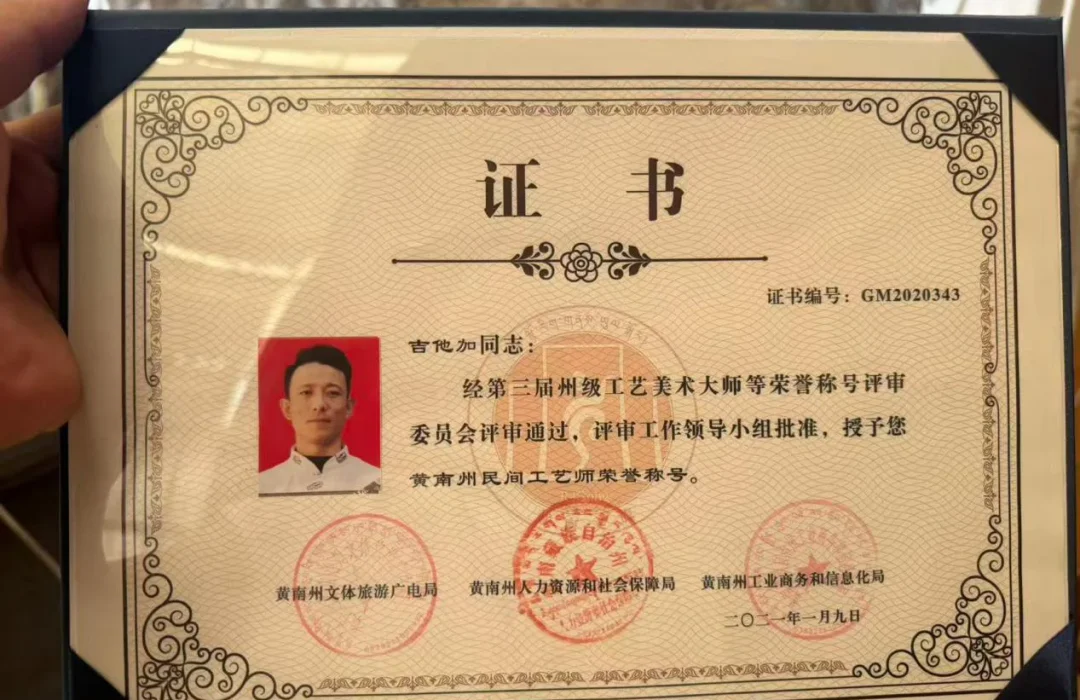
吉他加
A Thangka Painter from Regong — Meet Jijiajia
The people from Thangka Treasure came to Regong and asked if I would tell my story. All right, I said. Let me tell it.
I am Jijiajia. I paint thangkas. I was apprenticed at the age of eleven, and I have been painting for more than twenty years.
1. At eleven, I gave my life to the brush line
In Regong, many children grow up watching the elders paint. So did I. When I was eleven, my master took me in. He did not start by teaching me to paint Buddhas — first he made me grind pigments and train my brush line. Day after day, stroke after stroke. Back then I did not know the word “discipline”; I only knew that if I painted badly, I would do it again the next day.
Later I understood: a thangka cannot be rushed, and it cannot be fooled.
2. Others master one school; I insisted on mastering both
Regong thangka has two great schools. The Mentang school paints with soft, graceful lines — the most beautiful for the compassionate Buddhas and Bodhisattvas. The Chinze school uses firm, powerful strokes — best for the wrathful figures, the vajra-holding guardians. Most painters devote a lifetime to one school, because the two differ completely in composition, line and color logic. To truly master one is already an achievement.
I was greedy. I wanted both. And I paid for it — in the early years my works often “mixed flavours” by accident: the softness of Mentang interrupted by the force of Chinze. A painting would fail, and I would start over. Painting by painting, I slowly absorbed the rules of both schools into my hand, until they became my own style.
3. Chemical pigments are easy. I don't touch them.
Many thangkas today are painted with chemical colors — fast, cheap, and “bright”. Not for me.
I keep the old Tibetan way: natural minerals — cinnabar, lapis lazuli, turquoise — must be crushed, soaked, settled and filtered over and over before they become the painting’s main colors. Gold must first be beaten into foil, then ground by hand into a fine golden paste for the Buddha’s halo, robes and ornamental patterns. The whole process of preparing colors and gold takes far longer than squeezing paint from a tube.
But slow has its rewards. Natural mineral colors are warm and deep; they do not fade over decades, and they carry a quiet solemnity no chemical can ever imitate.
4. The great wall and the small canvas — both are my battlefield
I paint two kinds of works: fine thangkas of modest size, made for collection and devotion, and vast monastery murals. Years of traveling the Tibetan regions to paint temple walls have taught me to hold the composition of a giant wall and to refine a line as fine as a single hair on a small thangka. Few painters can do both. I often feel this “two-sided” skill was fed to me by the monasteries and by time itself.
5. Ten years, 288 works, not one with a skipped step
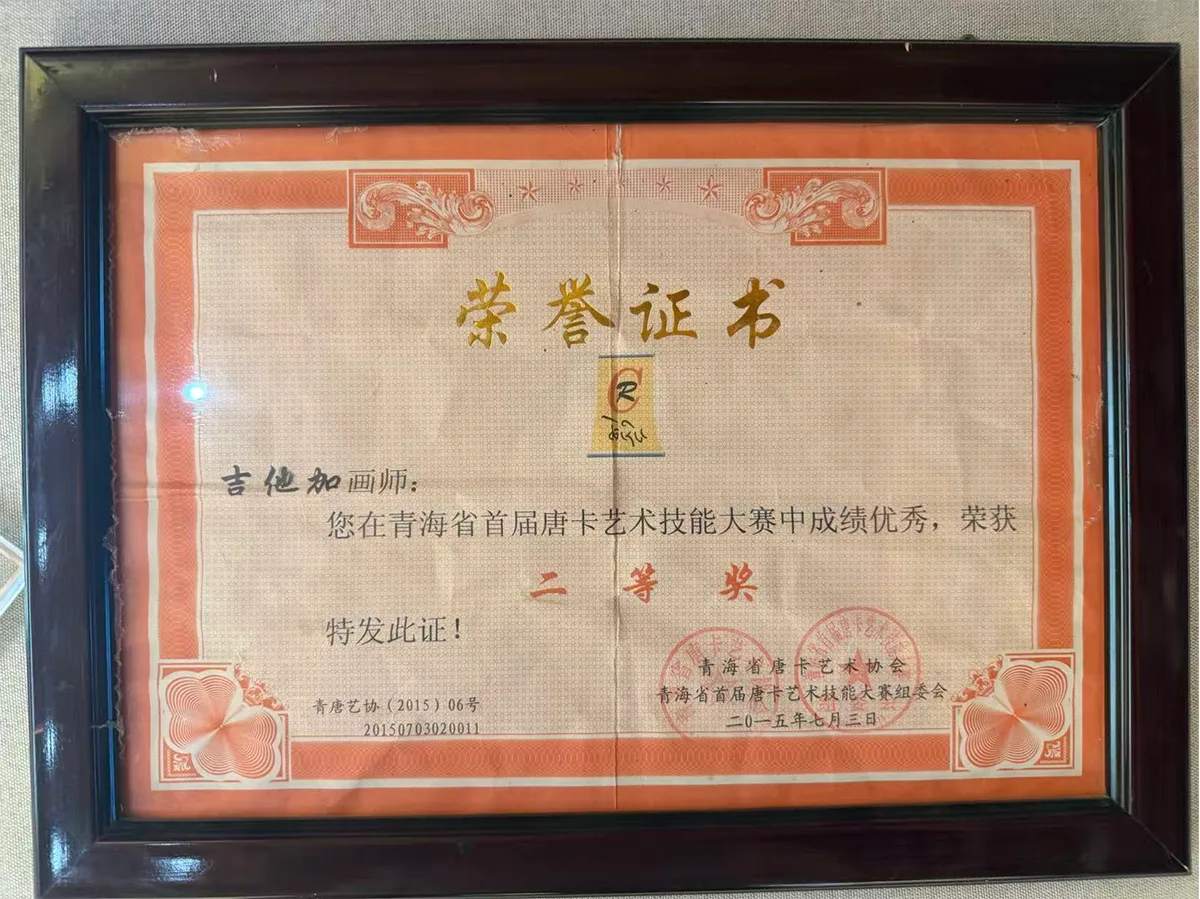
From 2015 to 2025 I quietly painted 288 orthodox fine thangkas. Every single one completed the full process — measuring and drafting, mineral coloring, hand-applied gold — and not one had a single step simplified.
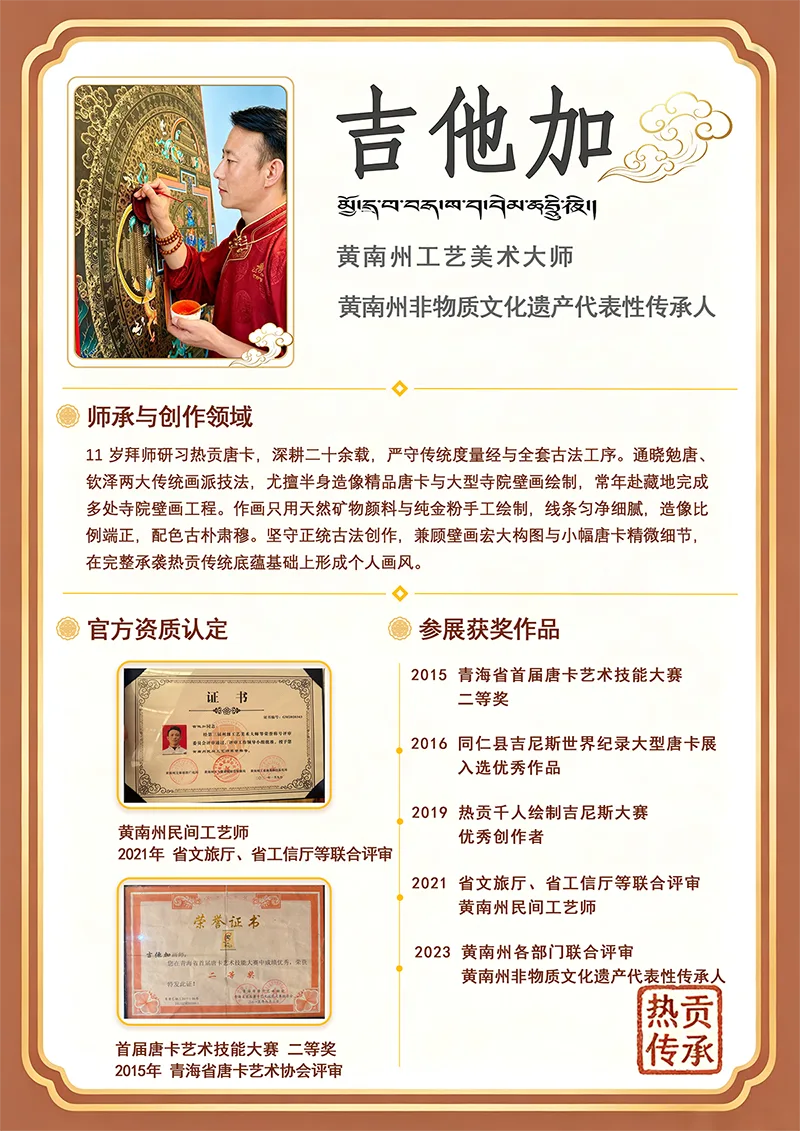
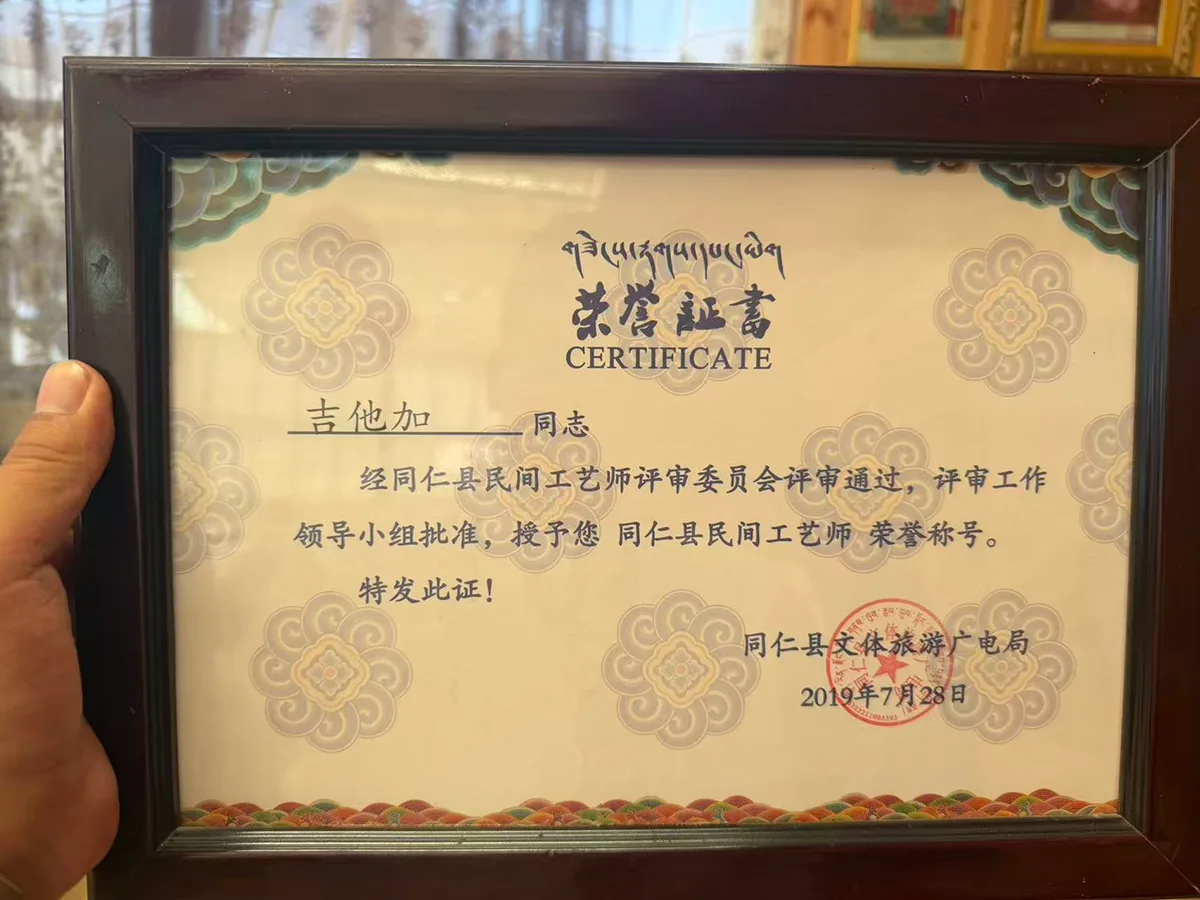
Many of these paintings have left Qinghai and are now in permanent collections of galleries and museums at home and abroad, standing as living examples of the Regong thangka that blends two schools. In 2019, I took part in the Guinness World Records thangka creation project in Tongren; my work was selected for the grand exhibition, and I was named an outstanding creator in the thousand-painter Guinness event.
6. It is not enough that I can paint. I wrote the craft down.
For centuries, thangka painting was passed down only from master to apprentice, by word of mouth. So much could only be felt, never spoken. I kept thinking this was not enough — what if, in the handing down, something got lost?
So I began to write. Drawing on decades of mural and thangka practice, I set down in books the practical essentials of iconometric measurement, the making of natural mineral pigments, and the techniques of blending the Mentang and Chinze schools. I have independently written and published four books on thangka art. Some say it is rare for a working painter to publish professional books in this craft. I do not think it is a great achievement — but at least, from now on, those who wish to learn can sit with a book as well as with a master.
7. Regong is poor, but painting leaves the children a path
To be honest, Regong is quite poor. The mountains are many and the land is thin; farming alone cannot support a family, and many young people go away to work in the cities. As for the children — many finish middle school and their families can no longer afford to keep them in school.
In Regong, thangka is one of the few ways a child can earn a living with a skill. So I never choose my apprentices by family background. For those in difficulty, I reduce the fees — or waive them. If a child can sit still and truly wants to learn, I teach. When the weather turned cold, I have even fed them.
Among the fifty or sixty apprentices I have trained, many were children from the mountains. When they first came, they could not even tell one pigment from another, so I started them on grinding colors and training the brush line, stroke by stroke. When they mastered it and could paint on their own, some went home and set up their painting tables in their own courtyards, supporting their families with this craft, and their lives grew better day by day. Once, when I went to a village on errands, I saw from afar a thangka he had painted hanging on his courtyard wall. That moment made me happier than any prize.
And the apprentices who followed me to paint monastery murals — they would stay in the temple for months; when the work was done, the skill had grown into their hands. In a poor place, that is a livelihood for life.
I often tell my apprentices: a thangka painter must hold the Buddha in his heart, keep discipline in his hand, and keep people in his sight. I can help only a limited number of children — but every one I help is one more person in Regong who stands on his own skill. That matters more to me than painting a few more thangkas.
8. I teach my apprentices — never the shortcut
Over the years I have trained more than fifty apprentices. My way of teaching is the same as my way of learning: I do not rush them to copy finished works. First I teach them to recognize and grind natural mineral pigments, to know the making of pure gold paste. Then I teach the proportional canon of the iconometric texts, step by step, breaking down the line and color techniques of both schools, and finally — using my own mural experience — how to hold the composition of a large wall.
Some have advised me to teach faster, so students produce work sooner and money comes sooner. I refuse. My creed is eight words: hold to the ancient ways, paint with devotion. No step may be skipped, no measure changed, no reverence for the sacred image lost.
9. What is in my heart
People ask me: painting so slowly — is it worth it? A fine thangka takes months, sometimes half a year. In a lifetime, the number I can paint is countable.
But when I think about it, it is worth it. My paintings are in permanent collections, windows through which others come to know Regong thangka. My books sit on desks, giving those who wish to learn a path. My apprentices are working at their painting tables, carrying on the road I could not finish — and the children from the mountains are now masters to others. On monastery walls, the colors I left are still quietly keeping watch over the Buddhas.
This is exactly why I am willing to work with Thangka Treasure. They did not come to Regong to stock up on goods — they came to tell the story of the thangka to the world, properly and respectfully. Their conviction is the same as mine: ancient ways, orthodox craft, nothing simplified.
That Regong’s craft is seen by more people, and that the blessings of the highlands travel farther — this is the result I have wanted most in more than twenty years of painting.
— Jijiajia, Intangible Heritage Painter of Regong
